Home Additions on Long Island: Types, Permits, and What to Expect
Long Island homeowners are adding onto their homes instead of selling — and the math makes sense. Here is what you need to know before you start.
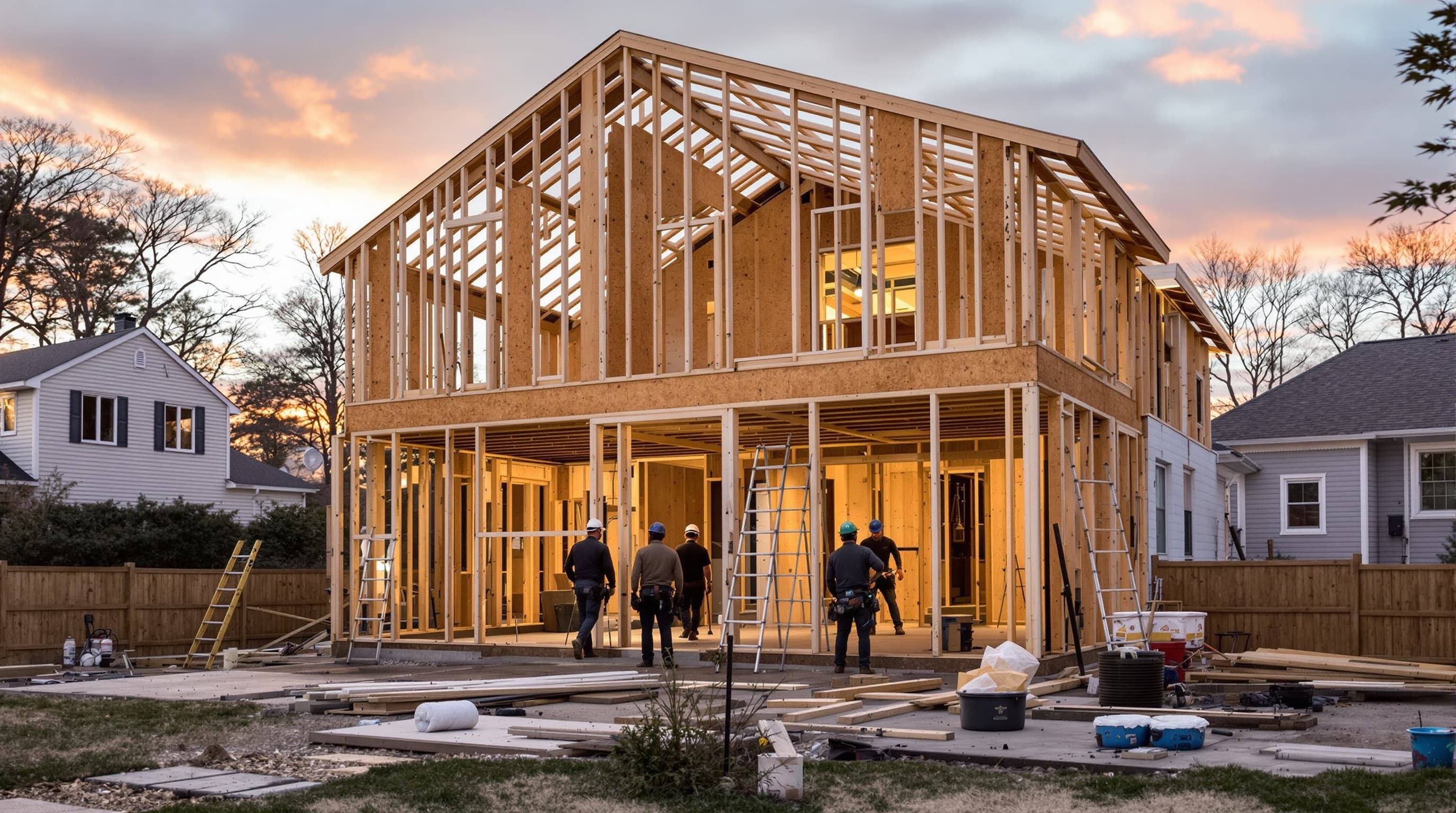
Moving to a bigger house on Long Island in 2026 means competing for limited inventory, paying 7 to 8 percent on a new mortgage, and covering transfer taxes on a price that has risen sharply since 2020. A home addition delivers the same square footage at a fraction of that effective cost — and you keep the mortgage rate you already have. That is why rear additions, in-law suites, and second-story pop-tops have become the go-to move for Nassau and Suffolk County families who need more space but do not want to lose their home.
This guide covers the types of additions most common on Long Island, what the permit and approval process looks like in Nassau and Suffolk, the structural realities specific to LI housing stock, and what separates a well-run addition project from one that runs over budget and over schedule.
Types of home additions on Long Island
Rear additions
The most common addition in Nassau and Suffolk County. A new room, expanded kitchen, or suite is added to the back of the house on a new foundation. Size typically runs 300 to 700 square feet. Rear additions work well on colonials, ranches, and split-levels — the building types that dominate LI's housing stock. Cost typically runs $75,000 to $180,000 depending on size, foundation type, and whether the connection requires structural work on the existing rear wall.
In-law suites
Multi-generational living has driven strong demand for in-law suite additions across Nassau and Suffolk. These typically require a separate entrance, a full bathroom, a bedroom, and at minimum a kitchenette. Most Long Island towns have specific zoning codes for accessory dwelling units — Hempstead, North Hempstead, and Oyster Bay all have owner-occupancy and parking requirements that need to be resolved at the permit stage, not discovered at the final inspection. A new in-law suite addition off the first floor typically runs $145,000 to $250,000. A garage conversion to a finished in-law suite can typically run $85,000 to $145,000 because the shell already exists.
Garage conversions
Converting an attached garage to living space is one of the most cost-effective ways to add square footage on Long Island. The footprint and roof are already there. The scope focuses on insulation, HVAC, electrical, drywall, and finish work — plus proper egress if the converted space will serve as a bedroom. Timeline is typically shorter than a ground-up addition: 3 to 5 months from signed contract to Certificate of Occupancy.
Bump-outs
A bump-out is a smaller extension — typically 50 to 200 square feet — that pushes one room out to gain meaningful usable space without a full addition footprint. Common applications: expanding a cramped kitchen by 8 to 10 feet, adding a breakfast nook to a dining room, or creating a mudroom off the back door. Bump-outs still require permits and foundation work, but the scope is tighter. Cost typically runs $25,000 to $55,000 for most Long Island bump-outs.
Sunrooms
A three-season or four-season sunroom extends the living area without the structural complexity of a full addition. Three-season sunrooms with standard insulation typically run $40,000 to $75,000. Four-season sunrooms with full HVAC integration and insulated glazing typically run $65,000 to $120,000. Important distinction: a sunroom with a concrete foundation and HVAC connection is a permitted addition; a prefab screen room on a deck is not — and it does not add appraised value the same way.
Second-story additions
The most ambitious scope: removing the existing roof and building a full new floor on top of the first-floor walls. Delivers the most square footage per dollar of footprint on small lots. Requires structural engineering review of the existing first-floor framing and often foundation underpinning on pre-1975 ranches. Cost typically runs $180,000 to $350,000 depending on size, structural conditions, and finish level. For full detail, see our second-story addition cost guide.
Nassau County permit process
Any structural home addition in Nassau County requires a building permit filed with the appropriate local building department before work begins. The process works like this:
- Architectural drawings and engineering stamp. Plans must show existing conditions, proposed addition, structural connections, and code compliance. A licensed engineer or architect stamps the drawings.
- Permit application. Filed with the local building department — Town of Hempstead, Town of North Hempstead, Town of Oyster Bay, or the applicable incorporated village building department. Incorporated villages (Garden City, Great Neck Plaza, Westbury, Mineola) have separate building departments from the surrounding town.
- Review and approval. Typical review time is 6 to 10 weeks for straightforward additions. Projects that require a variance from setback, lot coverage, or height requirements go before a Zoning Board of Appeals — add 3 to 6 months.
- Inspections during construction. Nassau County building departments require inspections at foundation, framing, rough electrical, rough plumbing, insulation, and final stages.
- Certificate of Occupancy. Issued after final inspection confirms the completed addition matches the approved plans. The CO is required to legally occupy the space and must be disclosed in any future home sale.
Suffolk County permit process
Suffolk County uses the same basic framework — building permit, inspections, Certificate of Occupancy — but each of the ten towns manages its own building department. There is no county-level building department for residential work. This matters because timelines, setback rules, and ADU regulations vary from town to town.
- Town of Huntington — Building Department in Huntington village. ADU regulations updated in 2022.
- Town of Islip — covers Bay Shore, Bayport, Bohemia, Brentwood, Central Islip, East Islip, and others. Permit review typically 5 to 9 weeks.
- Town of Babylon — covers Babylon village, Lindenhurst, North Babylon, West Babylon, and surrounding communities.
- Town of Brookhaven — largest town by area in Suffolk. Permit review can run longer given volume.
- Town of Smithtown — covers Kings Park, Commack, Nesconset, St. James, Hauppauge.
Knowing which building department governs your parcel — and which rules apply — is part of what a qualified Long Island home addition contractor brings to the table. Getting it wrong wastes months.
Structural considerations specific to Long Island
Long Island's housing stock has structural characteristics that affect how additions are designed and built. A contractor who works regionally but does not have deep LI experience will encounter surprises. A contractor who has been doing additions on this island for decades will already know what to expect.
- Slab-on-grade foundations.A significant portion of LI's post-WWII ranch and Cape Cod stock — particularly in the Levittown-era developments in Nassau County — was built on slab-on-grade foundations with no basement or crawl space. Rear additions on these homes need a proper continuous footing below the frost line (42 inches in Long Island) to prevent frost heave. Additions poured directly onto or adjacent to an existing slab without proper footing depth will settle and crack within a few seasons.
- Shallow basements. Many LI homes have partial basements or basements with lower-than-current headroom. Second-story additions that transfer significant load down to the existing foundation need a structural engineer to evaluate whether underpinning or reinforcement is required. On roughly 40% of pre-1975 ranches, some underpinning is needed.
- Older framing systems. Pre-1970s homes on LI were often framed with true-dimension lumber and non-standard stud spacing. When connecting a new addition to an existing exterior wall, the structural tie-in often reveals framing that does not match current code. This is normal and expected — a good contractor prices for it with a realistic contingency line, not a change-order surprise.
- Existing materials in the demo zone. Homes built before 1978 may have lead paint or asbestos-containing materials in the walls and roof materials that fall within the addition scope. Proper testing and abatement procedures are legally required before demolition — and add cost. Nassau and Suffolk County contractors are required to follow NYS abatement protocols.
Cost ranges for Long Island home additions
Here are the working ranges for the most common addition types in Nassau and Suffolk County in 2026. For a full breakdown of what drives each number, see our detailed home addition cost guide.
- Bump-out (50–200 sq ft): $25,000 – $55,000
- Sunroom, three-season: $40,000 – $75,000
- Sunroom, four-season: $65,000 – $120,000
- Garage conversion to living space: $85,000 – $145,000
- Rear addition (300–600 sq ft): $75,000 – $180,000
- In-law suite addition: $145,000 – $250,000
- Second-story addition: $180,000 – $350,000
These ranges assume mid-grade finishes, standard permit jurisdiction (no variance required), and no major structural surprises in the existing framing. Foundation type is the single biggest variable — a basement adds 30 to 40 percent to a rear addition cost compared to slab. Finish level is another significant swing: moving from builder-grade to premium finishes on the same footprint can be a 2x difference on the interior scope.
For dormers specifically, see the Long Island dormer guide.
Get a real cost for your addition
the owner walks every prospective addition job personally — no salesperson, no estimator sent ahead. He brings a measuring tape and a notepad, looks at your structure, and delivers a real number within a week. No travel fees anywhere in Nassau or Suffolk County.
Book a walk-throughWhy hire LI Homeworks for your addition
Long Island home additions require a contractor who understands this market specifically — the permit jurisdictions, the housing stock, the zoning boards, and the structural conditions that come with building on a barrier island with a seasonal freeze-thaw cycle.
To see how we run an addition from the first survey to the final inspection, start with our page for a home addition contractor on Long Island.
- Nassau and Suffolk HIC licensed. LI Homeworks holds active Home Improvement Contractor licenses in both counties. This is a legal requirement for any addition work in New York — and it matters for your permit filings and your homeowner protection.
- 20+ years of LI addition experience. The owner has built rear additions, in-law suites, garage conversions, and second-story pop-tops across Nassau and Suffolk County for over two decades. He knows which building departments move quickly, which ones require additional documentation, and what structural surprises to price for before you sign a contract.
- Design-build approach. LI Homeworks handles design, engineering coordination, permit filing, construction, and final inspection under one contract. You are not managing an architect, a permit expediter, and a builder separately. One call, one point of accountability.
- Permit coordination included. Permit fees and permit coordination are line items in every LI Homeworks estimate — not buried in fine print or added as a change order after signing. We file the permits, track the review, schedule the inspections, and deliver your Certificate of Occupancy.
- Fixed-price written contract.The number on the contract is the number you pay, unless you initiate a scope change. No "unforeseen conditions" clauses that let a contractor increase the price without your approval.
Communities we serve
LI Homeworks serves addition clients across Nassau and Suffolk County, including:
Nassau County: Garden City, Hempstead, Levittown, Massapequa, Merrick, Mineola, New Hyde Park, Oceanside, Rockville Centre, Valley Stream, Wantagh, Westbury, Great Neck, Port Washington, Manhasset.
Suffolk County: Huntington, Melville, Commack, Hauppauge, Smithtown, Bay Shore, Babylon, West Islip, Lindenhurst, Patchogue, Ronkonkoma, Centereach, Setauket, Stony Brook, Northport.
Frequently asked questions
Do I need a permit for a home addition on Long Island?
Yes. Any structural home addition in Nassau or Suffolk County requires a building permit before work begins. Upon completion, you need a Certificate of Occupancy to legally use the space. Unpermitted additions create title problems at sale and can result in mandatory demolition orders.
How long does the permit process take?
Permit approval typically takes 4 to 12 weeks depending on the municipality and whether a variance is required. Nassau County towns generally run 6 to 10 weeks for a standard addition. Suffolk County towns vary — Huntington and Smithtown tend to be faster than Brookhaven on high-volume submittals. Projects requiring a Zoning Board of Appeals hearing add 3 to 6 months.
What are the setback requirements for a home addition?
Setbacks vary by town, village, and zoning district. Most residential R zones on Long Island require rear setbacks of 25 to 35 feet and side setbacks of 8 to 15 feet. Incorporated villages often have stricter requirements with separate zoning boards. Your contractor should pull the current setback requirements from the applicable building department before you finalize plans — not after.
How much does a home addition cost on Long Island?
Bump-outs typically run $25,000 to $55,000. Rear additions typically run $75,000 to $180,000. Second-story additions typically run $180,000 to $350,000. Foundation type, structural tie-ins, finish level, and permit jurisdiction all affect the number. See our home addition cost guide for detailed breakdowns.
How do I find a reliable home addition contractor on Long Island?
Look for a contractor with an active Home Improvement Contractor license in both Nassau and Suffolk County, verifiable references for completed LI additions (not just remodels), and a fixed-price written contract that includes permit fees and engineering costs as line items. Confirm they handle permit filing themselves and have a track record with the building departments in your specific town.