
Home Addition Cost on Long Island (2026)
Long Island home additions range from $85,000 in-law suite conversions to $650,000 full second-story pop-tops. Here is the honest breakdown of what drives that number — and how to tell if a bid is real.
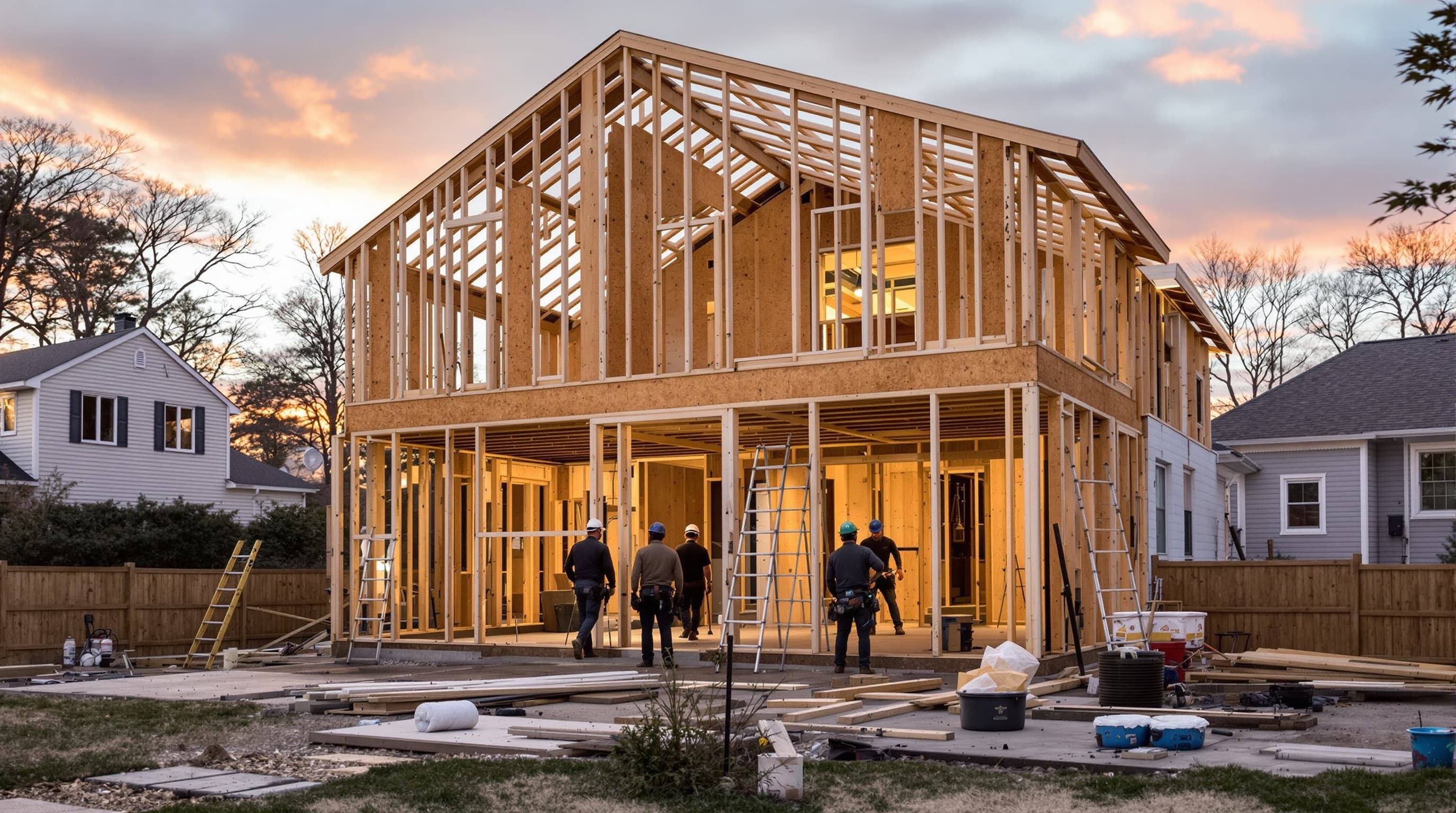
Home additions on Long Island in 2026 run between $220 and $385 per square foot for new living space — but that range is almost useless without context. A 400 sq ft rear bump-out on a 1960s colonial costs very differently per square foot than a 1,200 sq ft in-law suite over an existing garage, even though both are "additions." What you are really buying is engineered square footage, and Long Island's structural, permit, and zoning realities shape the cost as much as the size does.
The four main types of home additions on Long Island
1. Rear addition — $155,000 to $340,000
The most common addition in Nassau and Suffolk County. A new room, suite, or kitchen expansion added to the back of the house on a new foundation. Size typically runs 300–700 sq ft. Cost drivers: foundation type (slab vs. full basement), whether the existing rear wall needs structural reinforcement, and whether you are tying into an original 1950s–70s structure that may have lead, asbestos, or undersized wiring in the demo zone.
A straightforward 400 sq ft rear family-room addition on a ranch — slab foundation, standard openings, mid-grade finishes — typically runs $155,000–$200,000 with permits. A 600 sq ft rear addition with a full basement, new patio door opening in a load-bearing wall, and higher finishes typically runs $240,000–$310,000.
2. In-law suite addition — $145,000 to $295,000
In-law suites in Nassau County typically require a separate entrance, a full bathroom, a bedroom, and a kitchenette at minimum. Some towns (Hempstead, North Hempstead, Oyster Bay) have specific zoning codes for accessory dwelling units that require off-street parking compliance, separate utility connections, and owner-occupancy affidavits. We navigate these requirements on every in-law suite project — getting it wrong results in a certificate of occupancy hold at the end of a six-figure project.
An in-law suite addition off the first floor (300–450 sq ft, separate entrance, full bath, kitchenette) typically runs $145,000–$220,000. A garage conversion to a full in-law suite is often less expensive — $85,000–$145,000 — because the structure already exists, but the insulation, HVAC, and electrical scope can be extensive on an unfinished garage.
3. Full second-story addition — $285,000 to $575,000
The biggest residential scope most Long Island families will commission. Removes the existing roof, builds a full new floor on top of the existing first-floor walls, and installs a new roof. Foundation underpinning is required on roughly 40% of the pre-1975 ranches we work on. HVAC either extends the existing system or gets a dedicated second-floor zone. Timeline: 9–14 months from signed contract to final certificate of occupancy.
For more detail, see our dedicated second-story addition cost guide.
4. Dormer addition — $75,000 to $145,000
Technically a roof addition rather than a house addition, but it delivers the same result for Capes and hip-roofed colonials: more livable square footage without changing the footprint. A shed dormer on a Levittown Cape converting the half-story to a full primary suite typically runs $82,000–$105,000. A gable dormer for a single bedroom typically runs $75,000–$95,000.
See our full breakdown in the Long Island dormer addition cost guide.
Home extensions in Nassau County
On Long Island, a home extension usually means building out rather than up. It adds space to the back or side of the house on its own foundation. The cost works much like the rear addition above. Size, foundation type and finish level drive the number.
In Nassau County, the building permit comes from your town, city or village. Setback and lot coverage rules decide how far you can extend. Our home extensions page answers common questions about yard space, zoning and permits.
The six things that move the number most
- Foundation scope. A rear addition on a full basement runs 30–40% more than the same footprint on a slab. Underpinning the existing foundation adds $18,000–$45,000 on second-story projects. This is often the biggest surprise in a competitive bid — contractors who exclude it to win the job pass the cost along as a change order.
- Structural tie-ins. Opening a load-bearing wall to connect the addition to the house requires LVL beam replacement, new posts, and a structural engineering stamp. Simple wall removal typically runs $8,000–$18,000. Complex multi-opening tie-ins with point load transfers typically run $22,000–$45,000.
- Zoning compliance. Nassau and Suffolk County municipalities have setback requirements, lot coverage limits, and height restrictions that vary by town and village. Some Nassau villages (Garden City, Great Neck Estates, Mineola) have separate zoning boards from the county. Additions that require variances add 3–6 months and $5,000–$15,000 in legal and application costs. We identify zoning constraints at the scoping visit, before you spend money on drawings.
- HVAC integration. Extending an existing forced-air system to serve an addition: $6,000–$12,000. Installing a new mini-split zone for the addition: $8,000–$15,000. Full HVAC replacement to handle the increased load: $18,000–$35,000. The right answer depends on your existing system age and capacity.
- Finish level. Builder-grade finishes (standard cabinet lines, contractor-grade tile, hollow-core doors) vs. mid-grade (semi-custom cabinets, tile with larger format, solid-core doors) vs. premium (full custom, marble, Andersen windows) is roughly a 2x swing on finish costs for the same square footage. We price all three tiers at the scoping visit so you can see the trade-offs.
- Permit jurisdiction complexity. A project in a Town of Hempstead jurisdiction pulls one set of permits. A project in an incorporated village (Garden City, Great Neck Plaza, Westbury) within the town pulls village building permits, sometimes alongside town permits. Historic district properties in any jurisdiction add Architectural Review Board approval. Our permit coordinator tracks every filing — permit costs are itemized in your estimate, not a line-item surprise.
What a real Long Island home addition estimate looks like
A legitimate fixed-price home addition estimate on Long Island should include, as line items: demolition and site preparation, foundation work (type specified), framing and structural materials and labor, roofing scope, exterior sheathing and siding, windows and exterior doors, insulation, drywall, interior trim and millwork, flooring, paint, plumbing rough and finish (if bathrooms are included), electrical rough and finish, HVAC scope, permit fees (by jurisdiction), engineering costs (PE stamp), and a contingency line for unforeseen conditions in the existing structure.
Any estimate that gives you a lump sum with no breakdown is not a real estimate. Any estimate that excludes permit fees, engineering costs, or "any unforeseen structural conditions" without explaining what that means is leaving itself room to escalate.
the owner provides a fixed-price written contract on every LI Homeworks project. The number on the contract is the number you pay unless you initiate a change order for scope changes.
Timeline: what to expect
- Rear addition, no basement: 4–7 months from signed contract to CO. Design and permits 8–12 weeks; construction 10–14 weeks.
- Rear addition with full basement: 6–9 months. Foundation excavation and poured walls add 4–6 weeks to the schedule.
- In-law suite addition: 4–6 months. ADU zoning compliance review adds 4–8 weeks on the permit side.
- Second-story pop-top: 9–14 months. Longest timeline due to full structural engineering review and HVAC replacement scope.
Why additions are the right move in Long Island's current market
Long Island's housing inventory is constrained and prices have risen steadily since 2020. Moving up to a larger home in Nassau or western Suffolk today means competing for limited inventory at 2024–2026 prices, paying 7–8% mortgage rates if you're not all-cash, and covering 1–2% transfer taxes at the new price level. An addition delivers the same square footage at a fraction of the effective cost of buying a larger house — and you keep your existing mortgage.
The math is particularly compelling for families in the $600K–$900K home range in Nassau County. Adding 400–600 sq ft via a rear addition or in-law suite at $180,000–$280,000 typically adds $250,000–$400,000 in appraised value in the current market. That is a significantly better return than a comparable move-up transaction.
Get a real number for your addition
the owner walks every prospective addition job personally — no salesperson, no estimator. He brings a measuring tape and a notepad, looks at your structure, and gives you a real number within a week. No travel fees in Nassau or Suffolk County.
Book a walk-through