Dormer Additions in Nassau County, NY: Costs, Contractors & Permits
Nassau County has more than 95 incorporated villages, a dense stock of postwar Cape Cods, and some of the most varied permitting jurisdictions on Long Island. Here is what a dormer addition actually costs here, what permits you need, and what to expect from the Nassau County building process.
Why Nassau County is Long Island's busiest dormer market
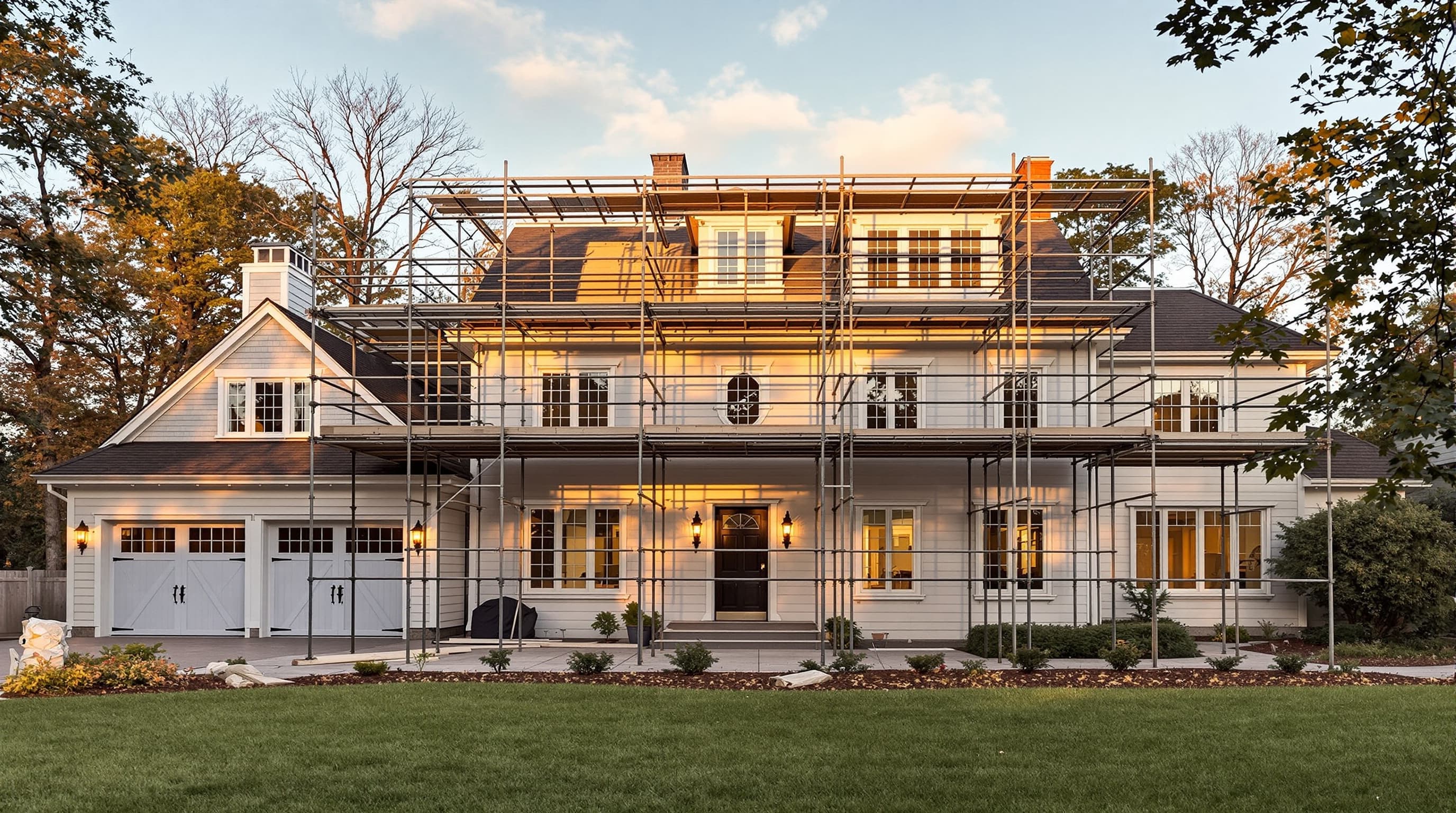
Nassau County contains the highest concentration of postwar Cape Cods on Long Island. Levittown alone has more than 17,000 original Levitt homes, a significant portion with unfinished second floors that were built to be expanded. Hicksville, Massapequa, Wantagh, Seaford, Uniondale, East Meadow, and the inner portions of Hempstead Town fill out the picture — tens of thousands of 1945–1965 Capes sitting on established lots with first-floor footprints that cannot expand outward because setbacks or neighbors are already there.
Our dormer addition service page covers the full process, from the first measure to the final inspection.
A dormer addition solves the Nassau County homeowner's core constraint: adding a bedroom or bathroom without buying a new house or building an addition that pushes into the yard. A full shed dormer on a standard Nassau Cape delivers 1,200–1,600 square feet of finished second-floor space — bedrooms, bathrooms, hallway, closets — for a fraction of what a larger home in the same school district would cost. That math is why dormers in Nassau County have a consistent ROI and why the permit offices in Hempstead, North Hempstead, and Oyster Bay see thousands of them.
2026 dormer cost ranges in Nassau County
Nassau County dormer costs run 15–25% above national averages. Three factors drive this: union labor rates in Nassau, required PE-stamped structural engineering on every job, and permit fees that are calculated as a percentage of the improvement value across most Nassau jurisdictions.
| Dormer Type | Structural Scope | Turn-Key |
|---|---|---|
| Shed dormer | $28,000 – $60,000 | $100,000 – $230,000 |
| Gable dormer | $22,000 – $48,000 | $80,000 – $155,000 |
| Multi-dormer Cape conversion | $50,000 – $95,000 | $155,000 – $295,000 |
| Hip dormer | $38,000 – $75,000 | $115,000 – $210,000 |
Turn-key includes structural engineering, permit filing and fees, framing, roofing, siding matched to existing, windows, interior rough-in (electrical, HVAC, insulation), drywall, flooring, trim, paint, and certificate of occupancy. Nassau County permit fees typically add $1,400–$4,500 depending on jurisdiction. Adding a bathroom rough-in adds $6,000–$16,000. Panel upgrade if required adds $4,500–$7,500.
The main cost variables in Nassau County: the specific permit jurisdiction (village vs. unincorporated town — village permits are often slower and occasionally more expensive), whether the home is in a Historic District requiring ARB review, the age and structural condition of the existing framing (pre-1970 Nassau homes frequently need ceiling joist reinforcement before a dormer can be built above them), and the finish level.
Permits in Nassau County: the 95-village reality
Nassau County's permitting landscape is the most complex on Long Island. The county has three towns — Hempstead, North Hempstead, and Oyster Bay — each with their own unincorporated-area building departments. Layered on top of that are more than 95 incorporated villages, most of which run their own building departments, codes, and processing queues entirely separately from the town.
What that means in practice: a homeowner in Valley Stream (an incorporated village) gets a permit from the Village of Valley Stream, not the Town of Hempstead. A homeowner a few blocks away in the unincorporated part of Hempstead goes to the Town. A homeowner in Garden City goes to the Village of Garden City — and if they are in the Historic District, they first need ARB approval before the building department will accept their permit application.
What every Nassau County dormer permit requires
- Full architectural drawings — floor plan, roof plan, exterior elevations, and window schedule for the proposed dormer
- PE-stamped structural engineering drawings — required by every Nassau jurisdiction. Covers framing plan, beam sizes, load paths, and foundation adequacy. Our structural engineer reviews every project.
- Site plan — current survey showing the lot, existing footprint, and setback compliance
- Energy compliance documentation — New York State ResCheck or equivalent for any new conditioned space
- ARB review package (Garden City Historic District, select villages) — elevation drawings, material specifications, color samples; takes 2–4 months
Garden City: the special case
Garden City has a Historic District covering roughly a third of the village. Dormer projects in the district require Architectural Review Board approval before the building department will issue a permit. Budget an additional 2–4 months and $2,500–$5,000 for the ARB process. For projects outside the Historic District, Garden City's building department typically processes in 5–8 weeks.
Processing time by Nassau jurisdiction
- Town of Hempstead (unincorporated): 4–7 weeks
- Town of North Hempstead (unincorporated): 5–8 weeks
- Town of Oyster Bay (unincorporated): 4–6 weeks
- Incorporated villages, standard: 4–8 weeks (varies significantly)
- Garden City (non-Historic District): 5–8 weeks
- Garden City (Historic District): Add 2–4 months for ARB
- Great Neck, Manhasset, Roslyn: 6–12 weeks
We file all permits in-house, track review status at each jurisdiction, and communicate with the building department on your behalf at every stage. Most Nassau County permit delays come from incomplete submission packages — engineering drawings that do not match the architectural drawings, or a missing survey. A complete first submission is the single biggest factor in processing time.
Which Nassau County homes benefit most
Cape Cods built between 1945 and 1965 are the primary candidate throughout Nassau County. The classic Nassau Cape — 800 to 1,100 square feet on the first floor, steep pitch above, unfinished attic with ceiling joists too small to support floor loads — was built with dormer expansion in mind. A full shed dormer converts that attic into 1,200–1,600 square feet of finished space without any work on the lot, the first floor, or the foundation.
Split-levels and raised ranches also qualify. Colonials do not typically need dormers — they already have full second-floor headroom. Ranch homes can be dormered when the roof pitch is sufficient (usually 8/12 or steeper), though structural reinforcement is more extensive than on a Cape because ranch ceiling joists are even smaller.
Where Nassau County dormer ROI is strongest: Levittown, Hicksville, Massapequa, Wantagh, and Seaford. A $400,000–$450,000 Cape in these communities with a complete dormer conversion typically appraises at $520,000–$620,000 — a return of 90–120% on the turn-key project cost. The Nassau County market rewards finished square footage because the alternative (buying a larger home in the same school district) costs significantly more.
See our complete dormer additions guide for Long Island for coverage of both Nassau and Suffolk County considerations, or browse our project portfolio to see completed Nassau County dormers.