Dormer Additions on Long Island: What They Cost and What Permits You Need
Long Island's stock of postwar Cape Cods was built with dormer additions in mind — the unfinished half-story overhead is waiting. Here is what it actually costs in 2026, what permits you will need, and which homes benefit most.
What is a dormer, and why do Long Island homeowners add them?
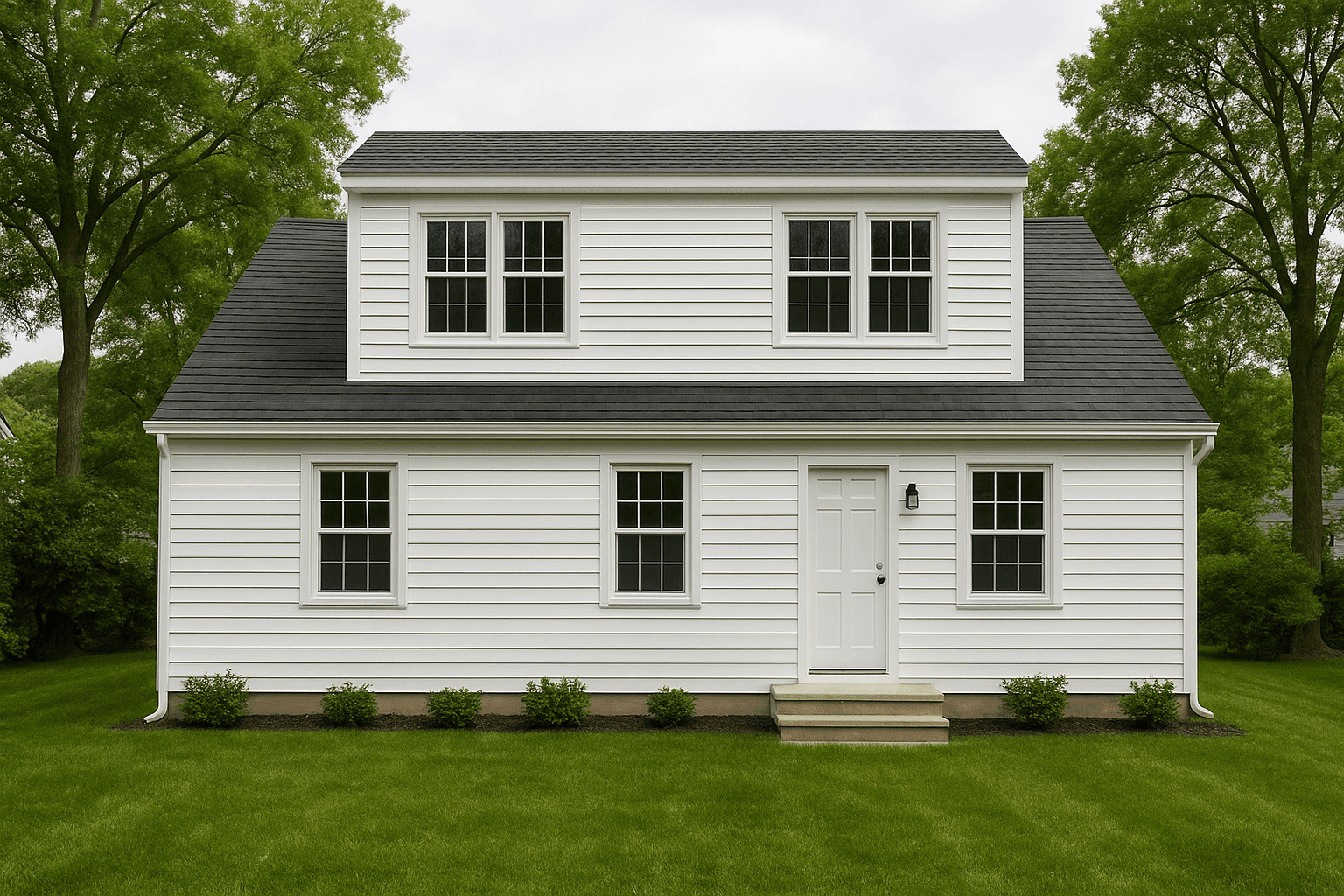
A dormer is a structural projection built into a sloped roof, creating vertical wall space, headroom, and windows where a cramped attic ceiling used to be. On Long Island, dormers serve one primary purpose: converting the unusable half-story above a Cape Cod or ranch into finished living space.
For the design, permit and build process, see our dormer additions page.
Long Island's postwar housing stock — the Cape Cods built across Levittown, Hicksville, Massapequa, Wantagh, and much of Hempstead Town between 1945 and 1965 — was designed with an unfinished second floor that builders assumed would be expanded later. The rooflines are steep enough and the footprints large enough that a dormer addition can double the home's finished square footage without touching the foundation.
The three reasons Long Island homeowners add dormers: headroom on the second floor (the existing half-story often has standing room in only the center 8 feet), adding a bedroom or bathroom the family has outgrown, and bringing natural light into an otherwise dark attic space.
The four dormer types
Shed dormer. A single flat-sloped plane running the full width of the roofline. The most common type on Long Island — roughly 70% of jobs — because it delivers the most usable square footage per dollar. A full-width shed dormer on a standard 1,000–1,400 sq ft Long Island Cape adds 1,200–1,600 sq ft of finished second-floor space.
Gable dormer. A peaked dormer that matches or echoes the main roofline. Less square footage than a shed dormer but it preserves the traditional exterior character of Tudors, brick colonials, and historic homes — common on the North Shore and in incorporated villages with architectural review requirements.
Hip dormer. A three-sided sloped dormer that blends with hip-roofed homes. More framing complexity than a shed or gable, and costs more per square foot of added space. Best suited to hip-roofed colonials and raised ranches where roofline continuity matters.
Eyebrow dormer. A curved, arched dormer — primarily aesthetic. Found on estate homes, historic North Shore properties, and Hamptons custom builds. Expensive to frame, adds minimal livable square footage, but significantly elevates curb appeal on the right property.
2026 dormer cost ranges on Long Island
Dormer costs on Long Island run 20–40% above national averages. Union labor rates in Nassau and Suffolk are among the highest in the country. Structural engineering is required on every job. And Long Island's postwar framing — ceiling joists sized for drywall, not floor loads — almost always requires reinforcement before a dormer can be built on top of it.
Here are 2026 structural-scope ranges (framing, roofing, siding to match, windows, and exterior work only — no interior finish):
| Dormer Type | Structural Scope | Turn-Key (incl. finish) |
|---|---|---|
| Shed dormer | $25,000 – $55,000 | $95,000 – $215,000 |
| Gable dormer | $20,000 – $45,000 | $75,000 – $145,000 |
| Multi-dormer Cape conversion | $45,000 – $90,000 | $145,000 – $285,000 |
| Hip dormer | $35,000 – $70,000 | $110,000 – $200,000 |
Turn-key cost includes structural engineering, permits, framing, roofing, siding to match existing, windows, interior rough-in (electrical, HVAC, insulation), drywall, finish flooring, trim, paint, and a certificate of occupancy. The number climbs if plumbing is involved (add $5,000–$15,000 for a bathroom rough-in), if the existing roof needs full replacement (add $18,000–$32,000), or if a panel upgrade is required (add $4,500–$7,500).
Nassau and Suffolk permit requirements for dormers
Every structural dormer addition on Long Island requires a building permit — no exceptions. What makes Long Island permitting distinctive is the number of jurisdictions involved. Nassau County contains more than 95 incorporated villages, each with its own building department, zoning code, and in some cases an Architectural Review Board. Suffolk County has 10 towns each running their own permitting offices.
What is required for a dormer permit
- Architectural drawings — full construction documents showing the proposed dormer, roof plan, floor plan, and elevations
- Structural engineering drawings — PE-stamped plans covering framing, beam sizing, load paths, and foundation adequacy; required by every Long Island building department
- Site plan — lot survey showing existing footprint and setbacks
- Energy compliance forms — New York State requires documentation of insulation and window values for any new conditioned space
Garden City: the special case
Garden City has a Historic District covering about a third of the village. Dormer projects in the district require Architectural Review Board approval — elevation drawings, material specifications, and a board presentation — before the building department will issue a building permit. Budget 2–4 additional months and $2,000–$4,000 for the ARB process.
Permit processing time across most Long Island townships runs 4 to 8 weeks for a standard dormer. East End townships — Southampton, East Hampton — add time: expect 10 to 20 weeks. Nassau County incorporated villages with their own departments vary from 3 weeks in some to 10+ weeks in others. We file every permit in-house and track review status with every jurisdiction.
Permit fees across Long Island typically run $1,200 to $4,000 for a standard dormer, calculated as a percentage of the assessed improvement value. East End townships charge more.
Which Long Island homes benefit most from dormers
Cape Cods are the primary candidate — and Long Island has tens of thousands of them. The classic Long Island Cape was built between 1945 and 1965 with 800 to 1,100 square feet on the first floor and a steeply pitched roof above, hiding an unfinished attic designed for eventual expansion. A full shed dormer converts that attic into 1,200 to 1,600 square feet of finished living space — bedrooms, bathrooms, hallway — without adding a single square foot to the home's footprint.
The densest concentrations of Cape Cods on Long Island: Levittown, Hicksville, and Massapequa in Nassau County; Babylon, Bay Shore, and western Huntington in Suffolk County. These neighborhoods are also where dormer ROI is strongest — a $400,000 Cape that receives a $120,000–$150,000 dormer conversion typically appraises at $500,000–$600,000 afterward.
Split-levels and raised ranches also benefit, though the structural approach is different. Colonials rarely need dormers — they already have full second-floor headroom. Ranches can be dormered when the attic has enough pitch, though structural reinforcement is more extensive because ranch ceiling joists are sized even smaller than Cape joists.
Timeline: from permit to certificate of occupancy
A standard Long Island shed dormer takes 6 to 10 weeks from permit approval to completion. Here is the breakdown:
- Design and permit filing (6–12 weeks): Architectural drawings, structural engineering, permit application. Timeline varies by township — some Nassau towns are 3–4 weeks, others run 10+.
- Framing and weatherproofing (1–2 weeks): The critical phase. Roof is stripped, dormer is framed, sheathed, and made watertight — typically within 24 to 48 hours of opening the existing roof. Roofing, housewrap, and windows follow.
- Exterior finish (1–2 weeks): Siding matched to existing, trim, and caulking.
- Rough mechanicals (2–3 weeks): Electrical, HVAC ductwork or mini-split, insulation — each requiring inspection before covering.
- Interior finish (2–4 weeks): Drywall, paint, flooring, trim, fixtures.
- Final inspection and CO (1–2 weeks): Building department final, corrections if any, certificate of occupancy issued.
Total time from first consultation to certificate of occupancy: 4 to 7 months for most standard dormers. Larger Cape conversions, East End townships, or projects requiring a variance add 2 to 4 months.
What a turn-key dormer includes
A complete dormer addition from LI Homeworks covers every phase:
- Architectural drawings and PE-stamped structural plans
- All permit filings and inspection scheduling
- Demo of existing roofing in the dormer zone
- New framing — ridge, rafters, headers, floor joists reinforced to floor-load rating
- Roofing to match existing (asphalt, cedar shake, or synthetic as applicable)
- Siding matched to existing exterior — vinyl, cedar, fiber cement, or masonry as required
- Windows — energy-code-compliant, sized for egress if bedroom
- Electrical — new circuits, outlets per code, panel upgrade if needed
- HVAC — ductwork extension or mini-split installation
- Insulation — R-38 ceiling, R-21 walls per New York State energy code
- Drywall, paint, finish flooring, trim, and interior doors
- Final inspection and certificate of occupancy
For a deeper dive on specific topics: complete dormer types guide · detailed 2025–2026 cost guide · home additions service page · Nassau and Suffolk permit guide
Frequently asked questions
What types of dormers are most common on Long Island?
Shed dormers are by far the most common on Long Island — they run the full width of the rear roofline on a Cape Cod and deliver the most usable square footage. Gable dormers are popular on Tudors and colonials where a peaked roofline matches the existing style. Hip dormers suit hip-roofed colonials and raised ranches. Eyebrow dormers are rare and mostly decorative, found on estate homes and North Shore historic properties.
Do I need a permit for a dormer on Long Island?
Yes — every structural dormer on Long Island requires a building permit with full structural engineering drawings stamped by a licensed PE. Nassau County has 95+ incorporated villages with their own building departments. Some, like Garden City and Old Westbury, also require Architectural Review Board approval before a building permit is issued. Suffolk County's 10 towns each run their own permitting offices. Permit processing typically takes 4 to 8 weeks, longer in East End townships.
How much does a dormer addition cost on Long Island in 2026?
A shed dormer typically runs $25,000 to $55,000 for the structural shell — or $95,000 to $215,000 for a full turn-key project including engineering, permits, interior finish, electrical, and HVAC. A gable dormer typically runs $20,000 to $45,000 for shell scope. A multi-dormer Cape conversion typically runs $45,000 to $90,000 for structural scope, or $145,000 to $285,000 turn-key. Prices vary by structural condition, finish level, and permit jurisdiction.
How long does a dormer addition take on Long Island?
Expect 6 to 10 weeks from permit approval to completion for a standard shed dormer. Pre-construction — design, engineering, and permit filing — adds 6 to 12 weeks on top of that. Total project duration from first consultation to certificate of occupancy is typically 4 to 7 months.
Which Long Island neighborhoods have the most Cape Cods?
Levittown, Hicksville, Massapequa, Wantagh, Seaford, and much of Hempstead Town in Nassau County are dense with postwar Cape Cods. In Suffolk County, Babylon, Islip, and western Huntington have large concentrations. These 1945 to 1965 homes were built with unfinished half-stories designed for eventual dormer expansion.
Get a free estimate on your Long Island dormer
We visit your property, review your goals, and return a fixed-price quote — no ranges, no surprises, no obligation. We cover all of Nassau and Suffolk County.
Get a free estimate